

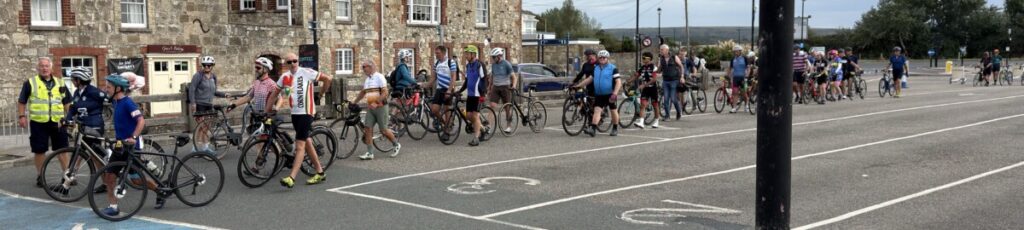
An inclusive cycling event taking place near Brockenhurst later this month will raise money to help people with disabilities and additional needs enjoy cycling in the New Forest – while also highlighting the very different forms that organised cycling can take within the National Park.
New Forest inclusive cycling charity PEDALL will hold its third annual Pass the PEDALL event at New Park Showground, Brockenhurst, on Saturday 26 September. The event marks the culmination of a summer campaign aiming to cycle a combined 10,000 kilometres and raise £10,000 for the charity.
PEDALL provides specialist cycles and guided rides for people who may otherwise find conventional cycling difficult or impossible. During 2025, the organisation worked with more than 50 organisations, including schools, colleges and residential care homes, and delivered 600 inclusive rides for more than 1,100 people.
At the September event, participants will be able to contribute to the fundraising distance by riding around a one-kilometre track at New Park, as well as trying some of PEDALL’s specialist cycles. Stalls and refreshments will also be available.
It is a very different proposition from the large road-based cycling events which have periodically proved controversial among New Forest residents.
Cycling and the New Forest
Few would dispute that cycling has benefits. It provides exercise, can reduce dependence on cars and allows residents and visitors to explore the Forest without adding another motor vehicle to its roads. The growth of electric bikes has also made cycling possible for a much wider range of people.
The New Forest National Park Authority supports cycling within the National Park, while Forestry England maintains a substantial network of designated gravel cycle routes across the Crown Lands.
For local businesses, cyclists can also form a useful part of the visitor economy, supporting cafés, pubs, cycle-hire businesses and shops. Cycling is therefore firmly established as one of the many ways in which people enjoy the New Forest.
But recreational cycling by individuals or small groups is not necessarily the same thing as a large organised cycling event.
Why large cycling events cause concern
The characteristics which make the New Forest attractive to cyclists can also create problems when hundreds of riders converge on the same roads.
Many Forest roads are narrow, winding and bordered by verges rather than pavements. They are not dedicated leisure routes: residents use them to get to work and home, while they are also shared by walkers, horse riders, commoners, agricultural vehicles and, importantly, free-roaming ponies, cattle and other livestock.
The New Forest National Park Authority acknowledges that concerns have been raised by local residents about cycling events, particularly the scale of some of the larger events and the behaviour of a minority of participants.
Those concerns led to the creation of the New Forest Cycle Event Organiser’s Charter, supported by organisations including the National Park Authority, New Forest District Council, Hampshire County Council, the Verderers of the New Forest, Forestry England and Hampshire Constabulary.
The charter recommends that organisers accept a maximum of 1,000 riders and that, where more than one event uses the same roads on the same day, their combined number should not exceed 1,000.
Events involving 500 or more riders can also be asked to provide detailed event and traffic-management plans.
There are particular New Forest considerations which would scarcely arise at a cycling event elsewhere. Between August and early November, for example, around 40 pony round-ups – known locally as drifts – take place. These can involve dozens of ponies moving at speed, and the cycling charter makes clear that the drifts take precedence over other activities.
The cumulative effect matters
For residents, the debate is not necessarily about whether cycling itself should be welcomed in the Forest. Often the concern is one of scale.
A dozen cyclists passing through a village is very different from several hundred riders following the same route within a few hours. Large groups can make overtaking difficult on narrow roads and potentially lead to queues of traffic behind riders. Busy events can also create additional pressure at junctions, car parks and refreshment stops.
There can be tensions with other Forest users too. The New Forest Equestrian Association has previously raised concerns with the Verderers about cyclists travelling at speed and frightening horses, alongside concerns about cycling away from permitted routes.
Responsible event organisers attempt to minimise such problems through careful route planning, staggered starts, rider briefings and liaison with the authorities. The National Park’s organiser charter specifically asks events to consider residents, businesses, other road users, livestock and other activities taking place in the Forest.
This is perhaps where the distinction between cycling and mass-participation cycling becomes most important.
Benefits have to be balanced against impact
Organised events can bring benefits. Participants may spend money with local accommodation providers, cafés, pubs and shops, while charity events can raise substantial sums and introduce people to cycling who might otherwise be excluded from it.
There are also clear health and wellbeing benefits associated with cycling, and initiatives such as PEDALL demonstrate particularly strongly how access to cycling can improve independence, confidence and social connection.
But National Park status inevitably means recreation has to coexist with conservation, commoning, wildlife, residents and other visitors.
The question is therefore less about whether cycling is “good” or “bad” for the New Forest than about what sort of cycling, where it takes place and at what scale.
A carefully managed inclusive event taking place principally around a one-kilometre course at New Park has a very different impact from hundreds or potentially a thousand cyclists travelling simultaneously along the Forest’s public roads.
Recognising that distinction could help take some of the heat out of a debate which has sometimes divided cyclists and residents.
Pass the PEDALL
Pass the PEDALL takes place at New Park Showground, Brockenhurst, on Saturday 26 September 2026.
PEDALL’s summer campaign began in June and, at the time of the National Park Authority’s announcement, participants had collectively ridden 7,775 kilometres and raised £6,700 towards the campaign’s targets of 10,000 kilometres and £10,000.
The money raised helps PEDALL maintain its fleet of specialist cycles, train and support volunteers and continue providing inclusive guided rides for people with additional needs.
For an organisation demonstrating that cycling in the New Forest can take many different forms, Pass the PEDALL may also offer a useful reminder that concerns about large-scale cycling events need not translate into opposition to cycling itself.
SOURCES
- New Forest National Park Authority
Riders invited to join cycling celebration and add to 10,000km for £10k fundraiser
New Forest Cycle Event Organiser’s Charter - Forestry England — Cycling in the New Forest
Cycling in the New Forest — Forestry England - Court of Verderers — February 2021 minutes
Court of Verderers — Minutes, 17 February 2021 (PDF) - PEDALL — Pass the PEDALL 2026
Pass the PEDALL 2026 — PEDALL
